
Project words
The issue of representing what cannot be seen or measured
Keywords:
representation, drawing, words, tasteAbstract
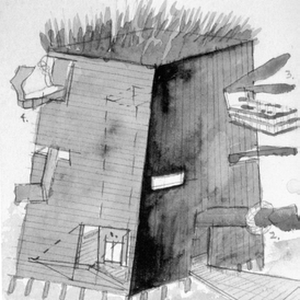
We have been taught and we have learned how to draw a croissant, how to measure it and how to lay it out. We could carry out the blueprints for building a set number of croissants. But, where does the taste fit in this process? How do we represent it? And, if the taste is missing, does architecture exist?
It seems that we need other means to represent (and reflect upon!) what we cannot see and measure.
Which is the relationship between drawing and text in architecture? We are dealing with not only representation but also project. Do drawings and words suffice to express everything that matters in a project?
The architectural discipline regards drawing as one of the most important tools in spite of the fact that it is bisected by textual and material dimensions. Therefore, an exclusively graphic perspective implies a meaningless reductionism.
The aim of this paper is to introduce the intersections lying between word and line as constitutive features of the project genesis considering that both of them should be present in order to attain mutual effectiveness.
Downloads
Downloads
Published
How to Cite
Issue
Section
License
Open access policy
A&P Continuidad is a non-profit and open access publication. According to Mexico Declaration on Cultural Policies, the journal distribution is submitted to Creative Commons Attribution-Noncommercial-ShareAlike 4.0 International Public License (CC BY-NC-SA). “Neither the commercial use of the original work nor that of the possible derivative works are allowed. The distribution of derivative works should be submitted to the license regulating the original work. This license is not free.”
A&P Continuidad authorizes the partial or full reproduction of texts and graphs provided that the source is cited. Authors are exclusively responsible for the criteria expressed in the articles which do not necessarily reflect the opinion of the Editorial Committee or that of the Direction Board. The copyright of the published articles pertains to their authors or publishers.
Transfer of rights
The acceptance of an article to be published implies the author’s transfer of rights to the journal. Authors continue to have the right to use the material in future books or publications, approve or veto the republication of their works as well as the rights related to patents or other rights. Transfer of rights form may be downloaded here.


























 This OJS site and its metadata are under a