
Objects of poetic reaction in the University City of Caracas
Brazilian and Corbusian influence
DOI:
https://doi.org/10.35305/23626097v12i23.505Keywords:
Carlos Raul Villanueva, Le Corbusier, Oscar Niemeyer, University City of Caracas, biomorphismAbstract
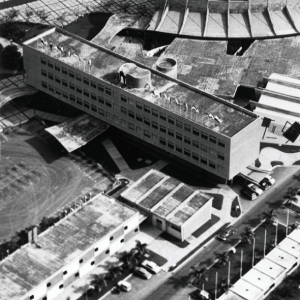
Based on the study of bibliographic, planimetric and photographic sources, this article focuses on the analysis of a group of buildings designed by Carlos Raul Villanueva in the University City of Caracas –during the 1950s– under the principles of Biomorphism, a renewing approach of the late 19th and early 20th century through which the predominance of objectivist and rationalist thinking was refuted and diversified, influencing architecture with a varied repertoire of sensitive, curved and irregular forms that acted as translations of the architect's imagination and his intuitive, free and poetic rhetoric. It is interesting here to trace and demonstrate the links of these ideas and those university buildings with the preceding concepts and models –such as Le Corbusier's objets à réaction poètique, introduced from painting in many of his modern architectural developments–, and their subsequent contemporary re-semanticization, also evaluating the Brazilian models, especially those developed by Oscar Niemeyer –another of the main exponents of an architecture characterized by these forms also seen as sensual and feminine– within the scope of renewal in 20th century architecture’s expressive codes.
Downloads
Metrics
References
Ábalos, I. (2004). Le Corbusier pintoresco. El pintoresquismo en la modernidad. Arquitectura. Revista del Colegio Oficial de Arquitectos de Madrid, 337, 50-59. https://www.coam.org/media/Default%2520Files/fundacion/biblioteca/revista-arquitectura-100/2000-2008/docs/revista-articulos/revista-arquitectura-2004-n337-pag50-59.pdf
Bil, G. (2022). The Representation of Plants. En S. Forbes (Ed.), A Cultural History of Plants in the Modern Era (Vol. 6, pp. 171-191). Bloomsbury Publishing.
Boesiger, W. y Stonorov, O. (Eds.). (2006). Le Corbusier et Pierre Jeanneret. Œuvre complète 1910-1929 (Vol. 1). Birkhäuser.
Bullaro, L. (2014). Moderno y tropical: la reinterpretación de los principios lecorbusierianos en las primeras obras de Oscar Niemeyer. Dearq, 1(15), 38-53. http://doi.org/10.18389/dearq15.2014.04
Bullaro, L. (2017). Oscar Niemeyer: ensayos tipológicos y morfológicos sobre la arquitectura de formas libres. Arquetipo, 15, 115-132. http://doi.org/10.31908/22159444.3678
Chávez Herrera, M. (2008). Accesos a la Ciudad Universitaria de Caracas: Plaza Venezuela. 1953-4 [Tesis de Maestría en Historia de la Arquitectura y del Urbanismo, no publicada]. Universidad Central de Venezuela.
Chávez Herrera, M. (2024). Villanueva lecorbusieriano: del racionalismo estructural a las Boîtes à miracles vènèzuèliennes. LC. Revue de recherches sur Le Corbusier, 10, 70-89. https://doi.org/10.4995/lc.2024.21095
Cohen, J. L. (2012). The Future of Architecture. Since 1889. Phaidon.
Cohen, J. L. (2018). Vida y obra de Le Corbusier (S. Landrove, Trad.). Gustavo Gili. (Trabajo original publicado en 2015)
Colquhoun, A. (2005). La arquitectura moderna. Una historia desapasionada. (J. Sainz, Trad.). Gustavo Gili. (Trabajo original publicado en 2002)
Dias Comas, C. E. (1999). Arquitectura moderna, estilo Corbu, pabellón brasileño. DC Papers. Revista de crítica y teoría de la arquitectura, 15(3), 67-77. http://hdl.handle.net/2099/1952
Fleig, K. (1998). Alvar Aalto. Obras y proyectos. Gustavo Gili.
González Mozo, A. (2021). Aire de familia. En A. González Mozo (Ed.), Leonardo y la copia de Mona Lisa del Museo del Prado. Nuevos planteamientos sobre las prácticas del taller vinciano (pp. 73-120). Museo Nacional del Prado.
Hernández, S. (2006). En busca de lo sublime. Villanueva y la Ciudad Universitaria de Caracas. Arte.
Jaua, M. F., Marín, A. M. y Rodríguez, M. A. (2009). Ciudad Universitaria de Caracas. Construcción de la utopía moderna. Fundación Centro de Arquitectura.
Marín, A. M. (Ed.). (2007). Ciudad Universitaria de Caracas. Patrimonio, 20 folletos. Fundación Centro de Arquitectura.
Mindrup, M. (2016). La Réaction Poètique of a Prepared Mind. En J. Torres Cueco (Ed.), Le Corbusier. 50 años después (pp. 1466-1473). Valencia, España: Universitat Politècnica de València. http://doi.org/10.4995/LC2015.2015.677
Negrón, M. (2008). Las transformaciones en el ordenamiento territorial venezolano entre las décadas de 1920 y 1950. En A. Jiménez (Ed.), Alfredo Boulton y sus contemporáneos. Diálogos críticos en el arte venezolano, 1912-1974 (pp. 46-59). Museum of Modern Art.
Niemeyer, O. (2005). My architecture. Revan.
Pintó, M., y Villanueva, P. (2001). Carlos Raúl Villanueva. Alfadil.
Pou Ruan, C. (2024). Villanueva y Caracas en la modernidad petrolera venezolana, 1930-1970. Monte Ávila.
Sbriglio, J. (1996). Immeuble 24 N.C. et appartement Le Corbusier = Apartment Block 24 N.C. and Le Corbusier’s home (S. Parsons, Trad.). Birkhäuser.
von Moos, S. (2009). Le Corbusier. Elements of a Synthesis. 010 Publishers.
Published
How to Cite
Issue
Section
License
Copyright (c) 2025 A&P Continuidad

This work is licensed under a Creative Commons Attribution-NonCommercial-ShareAlike 4.0 International License.
Open access policy
A&P Continuidad is a non-profit and open access publication. According to Mexico Declaration on Cultural Policies, the journal distribution is submitted to Creative Commons Attribution-Noncommercial-ShareAlike 4.0 International Public License (CC BY-NC-SA). “Neither the commercial use of the original work nor that of the possible derivative works are allowed. The distribution of derivative works should be submitted to the license regulating the original work. This license is not free.”
A&P Continuidad authorizes the partial or full reproduction of texts and graphs provided that the source is cited. Authors are exclusively responsible for the criteria expressed in the articles which do not necessarily reflect the opinion of the Editorial Committee or that of the Direction Board. The copyright of the published articles pertains to their authors or publishers.
Transfer of rights
The acceptance of an article to be published implies the author’s transfer of rights to the journal. Authors continue to have the right to use the material in future books or publications, approve or veto the republication of their works as well as the rights related to patents or other rights. Transfer of rights form may be downloaded here.




























 This OJS site and its metadata are under a