
The habitability in the center
Cuernavaca, between the abandonment of housing and the dynamism of its public spaces
DOI:
https://doi.org/10.35305/23626097v12i23.504Keywords:
habitability, historic center, housing, public spaceAbstract
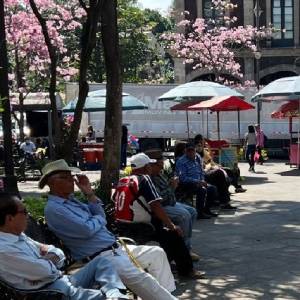
This study analyzes the habitability of Cuernavaca’s Historic Center from the perspective of its long-term residents focusing on access to housing and perceptions of public space safety. Through 60 in-depth interviews and mental maps, it explores the social, economic, and urban transformations of the past decade. Findings reveal a concerning rate of housing abandonment (33.6% of homes are unoccupied), a 30% increase in rental costs since 2020, and growing perceptions of insecurity linked to urban decay and the rising presence of homeless individuals. Despite this, public spaces remain active and valued for their cultural and social offerings. The conclusions emphasize the need for comprehensive public policies to regulate the housing market, rehabilitate abandoned buildings, and improve urban infrastructure. The applied methodology provides a solid foundation for replicating the analysis in other historic centers grounded on the participation of inhabitants. This work seeks to address strategies to strengthen community life and promote fair, safe, and sustainable urban development.
Downloads
Metrics
References
Borja, J. (2016). La ciudad conquistada. Alianza Editorial.
Carmona, G. G. (2018). Gentrificación contemporánea y derecho a la ciudad: la defensa del espacio urbano en la Ciudad de México. Revista de urbanismo, (39), 1-14.
Coulomb, R. (2009). Regeneración urbana y habitabilidad en los centros de ciudad. Lo aprendido en ciudad de México. Encuentro Latinoamericano sobre Centros Históricos, 1-20.
Cruz, N. E. G., Velasco, G. M., Sánchez, E. T., Gómez, M. G. O. y García, I. (2020). La producción social del espacio turístico en una comunidad chatina de la costa de Oaxaca. El caso de San José Manialtepec, Tututepec, Oaxaca. El Colegio de la Frontera Sur.
Delgadillo-Polanco, V. M. (2008). Repoblamiento y recuperación del Centro Histórico de la ciudad de México, una acción pública híbrida, 2001-2006. Economía, sociedad y territorio, 817-845.
DIF Cuernavaca. (2024). Reporte de personas sintecho Cuernavaca. Ayuntamiento de Cuernavaca.
Estrada, A. (19 de mayo de 2024). Reclaman comerciantes del centro de Cuernavaca mayor seguridad. La Jornada Morelos.
García, C. (1997). Apodos. La reconstrucción de identidades. estética de cuerpo, deseo, poder y psicología popular. Anthropologica, 419-421.
García, A. (2024, octubre 20). Más de 200 edificios abandonados ponen en riesgo el Centro Histórico de Xalapa. Diario de Xalapa. https://oem.com.mx/diariodexalapa/local/casas-abandonas-en-centro-historico-de-xalapa-cuantas-hay-y-por-que-no-se-restauran-13447762
Harvey, D. (2008). La libertad de la ciudad. Antípoda. Revista de antropología y arqueología, (7), 15-29.
INAFED. (2018). Enciclopedia de los municipios y delegaciones de México.
INEGI. (2020). Encuesta Nacional de Vivienda. CDMX.
INEGI, I. N. (20 de Agosto de 2021). Encuesta Nacional sobre la Dinámica de las Relaciones en los Hogares (ENDIREH). https://www.inegi.org.mx/programas/endireh/2021/
Instituto Nacional de Estadística, Geografía e Informática. (2024). Encuesta Nacional de Seguridad Pública Urbana (ENSU) .
Jacobs, J. (1961). Vida y muerte a las grandes ciudades. Random House.
Lefebvre, H. (1991). Critique of Everyday Life, Volume 1: Introduction (J. Moore, Trans.). London: Verso.
Milgram, S. (1977). Subject reaction: The neglected factor in the ethics of experimentation. Hastings Center Report , 19-23.
Congreso del Estado de Morelos. (2014). Periódico Oficial Tierra y Libertad. Gobierno del Estado de Morelos.
Orduña González, F., y Dzib Can, U. (2020). Análisis de las políticas públicas del turismo sustentable en el Centro Histórico de Santiago de Querétaro. Turismo y sociedad, 26.
Smith, N. (2002). Nuevo globalismo, nuevo urbanismo: la gentrificación como estrategia urbana global. Antipode, 34(3), 427-450.
Whyte, W. H. (1980). La vida social en pequeños espacios urbanos (Vol. 116). Washington, DC: Fundación para la Conservación.
Wilson, J., y Kelling, G. (1982). Broken windows: The police and neighborhood safety. The Atlantic Monthly, 29-38.
Ziccardi, A. (2016). Proceso y actores de la planeación participativa en centros históricos de ciudades mexicanas. Programa Universitario de Estudios sobre la Ciudad, Universidad Nacional Autónoma de México.
Published
How to Cite
Issue
Section
License
Copyright (c) 2025 A&P Continuidad

This work is licensed under a Creative Commons Attribution-NonCommercial-ShareAlike 4.0 International License.
Open access policy
A&P Continuidad is a non-profit and open access publication. According to Mexico Declaration on Cultural Policies, the journal distribution is submitted to Creative Commons Attribution-Noncommercial-ShareAlike 4.0 International Public License (CC BY-NC-SA). “Neither the commercial use of the original work nor that of the possible derivative works are allowed. The distribution of derivative works should be submitted to the license regulating the original work. This license is not free.”
A&P Continuidad authorizes the partial or full reproduction of texts and graphs provided that the source is cited. Authors are exclusively responsible for the criteria expressed in the articles which do not necessarily reflect the opinion of the Editorial Committee or that of the Direction Board. The copyright of the published articles pertains to their authors or publishers.
Transfer of rights
The acceptance of an article to be published implies the author’s transfer of rights to the journal. Authors continue to have the right to use the material in future books or publications, approve or veto the republication of their works as well as the rights related to patents or other rights. Transfer of rights form may be downloaded here.



























 This OJS site and its metadata are under a