
Daily life in El Mercadito urbanization (La Plata): contributions to the rehabilitation of monofunctional low-density housing.
DOI:
https://doi.org/10.35305/23626097v9i16.361Keywords:
daily life, social housing, rehabilitationAbstract
Theories of everyday life have built an innovative approach to massive habitat developments. Intersectional analyses warn about the impact of monofunctional ones. These social housing complexes -grounded on the paradigm of extensive use of territory and low density- cause segregation, insecurity, social exclusion and, in general, degradation of the urban use for the most vulnerable groups. The aim of this work is to make visible these consequences through the questioning of the conditions of a housing complex as a qualifier of urban space. What elements are to be considered to ensure equal opportunities by means of the benefits provided by the nearby city?
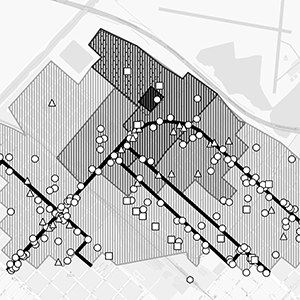
In methodological terms, the proposal is to deal with El Mercadito neighborhood (La Plata). This urbanization embodies a particular housing construction operation (Slums and Settlements Urbanization Subprogram). For this case study, georeferenced thematic maps are devised to identify transport networks, relationship spaces and equipment. Supra-neighborhood, neighborhood and neighborhood scales are considered.
Some of the results seek to contribute -from a critical analysis- to the identification of strategies for the rehabilitation of low-density monofunctional complexes weighing their effects on the access to the enjoyment of positive urban externalities.
Downloads
Metrics
References
Alcalá Pallini, L. (2007). Dimensiones urbanas del problema habitacional. El caso de la ciudad de Resistencia, Argentina. INVI, 22(59).
Arraigada, C. (2000). Pobreza en América Latina: Nuevos escenarios y desafíos para el hábitat urbano. Santiago de Chile, Chile: Naciones Unidas- CEPAL- ECLAC.
Bourdieu, P. (1993) La miseria del mundo. Madrid, España: Akal.
Ciocoletto, A. (2014). Espacios para la vida cotidiana. Auditoría de calidad urbana con perspectiva de género. Barcelona, España: Comanegra.
Cravino, M. (2008). Los mil barrios informales en el AMBA. Buenos Aires, Argentina: Universidad Nacional de General Sarmiento.
Cravino, C. (2009). Entre el arraigo y el desalojo. La Villa 31 de Retiro (Buenos Aires). Derecho a la ciudad, capital inmobiliario y gestión urbana. Buenos Aires, Argentina: Universidad Nacional de General Sarmiento.
Cravino, C. (2012). Construyendo barrios. Transformaciones socio-territoriales a partir de los Programas Federales de Vivienda en el Área Metropolitana de Buenos Aires. (2004-2009). Buenos Aires, Argentina: Universidad Nacional de General Sarmiento.
De Solá-Morales i Rubió, M. (2008). La segunda historia del Proyecto Urbano. DEARQ, 1, 30-41.
Del Río, J. P. (2012). El lugar de la vivienda social en la ciudad: Un análisis de la política habitacional desde el mercado de localizaciones intra-urbanas y las trayectorias residenciales de los habitantes. (Tesis doctoral, Facultad de Humanidades y Ciencias de la Educación, Universidad Nacional de La Plata, Argentina). Recuperada de: https://www.memoria.fahce.unlp.edu.ar/tesis/te.464/te.464.pdf
Di Virgilio, M. (2015). Producción social del hábitat: abordajes conceptuales, prácticas de investigación y experiencias en las principales ciudades del Cono Sur. Buenos Aires, Argentina: Ed. Café de las Ciudades.
Falú, A. y Segovia, O. (Eds.). (2007). Ciudades para convivir. Santiago de Chile, Chile: Ediciones Sur.
Fiscarelli, D. (2016). Adaptabilidad y vivienda de producción estatal: estrategias y recursos proyectuales. Subprograma de Urbanización de Villas y Asentamientos Precarios. 2005-2009. (Tesis doctoral, Facultad de Arquitectura y Urbanismo, Universidad Nacional de La Plata). Recuperada de: http://sedici.unlp.edu.ar/handle/10915/58682
Harvey, D. (2010). Ciudades rebeldes. Del Derecho a la Ciudad a la revolución urbana. Madrid, España: Akal.
Heller, A. (1977). Sociología de la vida cotidiana. Madrid, España: Península.
Jacobs, J. (1965). Muerte y vida de las grandes ciudades. Madrid, España: Península.
Kullock, D., y Murillo, F. (2010). Vivienda social en Argentina. Un siglo de estrategias espontáneas y respuestas institucionales. 1907-2007. Buenos Aires, Argentina: EUCASA.
Lefevbre, H. (1969). El Derecho a la Ciudad. Barcelona, España: Península.
Muxí, Z. (Coord.) (2013). Postsuburbia. Rehabilitación de urbanizaciones residenciales monofuncionales de baja densidad. Barcelona, España: Comanegra.
Pelli, V. (2007). Habitar, participar, pertenecer. Acceder a la vivienda-incluirse en la sociedad. Buenos Aires, Argentina: Nobuko.
Torrado, S. (2003). Historia de la familia argentina moderna (1870-2000). Buenos Aires, Argentina: Ediciones de la Flor.
Yujnovsky, O. (1984). Clave política del problema habitacional argentino. 1955-1981. Buenos Aires, Argentina: Grupo Editor Lat.
Published
How to Cite
Issue
Section
License
Open access policy
A&P Continuidad is a non-profit and open access publication. According to Mexico Declaration on Cultural Policies, the journal distribution is submitted to Creative Commons Attribution-Noncommercial-ShareAlike 4.0 International Public License (CC BY-NC-SA). “Neither the commercial use of the original work nor that of the possible derivative works are allowed. The distribution of derivative works should be submitted to the license regulating the original work. This license is not free.”
A&P Continuidad authorizes the partial or full reproduction of texts and graphs provided that the source is cited. Authors are exclusively responsible for the criteria expressed in the articles which do not necessarily reflect the opinion of the Editorial Committee or that of the Direction Board. The copyright of the published articles pertains to their authors or publishers.
Transfer of rights
The acceptance of an article to be published implies the author’s transfer of rights to the journal. Authors continue to have the right to use the material in future books or publications, approve or veto the republication of their works as well as the rights related to patents or other rights. Transfer of rights form may be downloaded here.





























 This OJS site and its metadata are under a