
From Babel to Dubai
Keywords:
height, representation, tower, powerAbstract
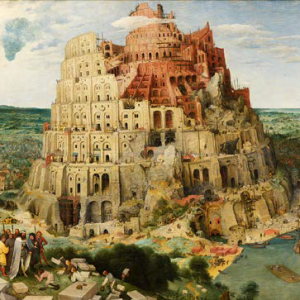
Alejandro Grimson argues that -according to the biblical narrative- God punishes both the excessive arrogance and the latent threat of those who attempt to reach sky by means of a tower since this jointly endeavor could make them as powerful as gods. This hypothesis assumes that God gave rise to a division among human beings in order to prevent them from achieving their goal: to get to heaven. Confused and unable to understand each other, they delayed the development of building technology. Nonetheless, Roman civilization attained the technical capacity to generate large unitary spaces. This evolution along with the development of modern engineering introduced increasingly amazing hallmarks as regards not only lighting but also, and mainly, height. While the ever more significant role of lighting implies an essentially pragmatic goal, that of height involves targets dealing with territory demarcation, urban densification, defense, communication and representation. Throughout history, men have attempted to build ever higher towers resembling that of Babel. This may be due to either their inferiority feelings when facing God’s power or their desire to emulate him as the world architect.
Downloads
Downloads
Published
How to Cite
Issue
Section
License
Open access policy
A&P Continuidad is a non-profit and open access publication. According to Mexico Declaration on Cultural Policies, the journal distribution is submitted to Creative Commons Attribution-Noncommercial-ShareAlike 4.0 International Public License (CC BY-NC-SA). “Neither the commercial use of the original work nor that of the possible derivative works are allowed. The distribution of derivative works should be submitted to the license regulating the original work. This license is not free.”
A&P Continuidad authorizes the partial or full reproduction of texts and graphs provided that the source is cited. Authors are exclusively responsible for the criteria expressed in the articles which do not necessarily reflect the opinion of the Editorial Committee or that of the Direction Board. The copyright of the published articles pertains to their authors or publishers.
Transfer of rights
The acceptance of an article to be published implies the author’s transfer of rights to the journal. Authors continue to have the right to use the material in future books or publications, approve or veto the republication of their works as well as the rights related to patents or other rights. Transfer of rights form may be downloaded here.





























 This OJS site and its metadata are under a