
Emerging urban landscapes
From systemic crises to the era of cities aimed at the common good
Keywords:
urban crisis, common, imaginaries, collective processes, emerging urban landscapesAbstract
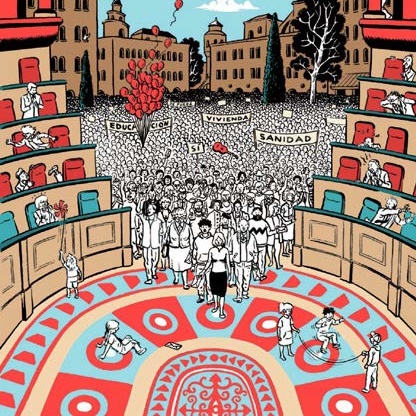
With the objective of facing the current global urban crisis, different groups have been building other possible urban landscapes thanks to the value of collective intelligence installed in the territory. The construction of new narratives of global struggles based on the paradigm of the “common”, networking, collectivization of life or the empowerment of community management as a form of organization are some of the mechanisms that some work teams have been promoting to create new urban landscapes that can meet the different needs and contemporary views of the urban. For this, the hypothesis that arises in the present text is that the construction of imaginary ones through collective processes and their implementation with focus in the human rights can constitute the base of new forms of territorial organization. Therefore, through the study of some urban representations and concepts in this regard and some glocal initiatives, it is proposed to highlight the convenience and productivity of transdisciplinary approaches and methodological positions capable of fostering the emergence of new professional roles that can shape these emerging urban landscapes for the 21st century.
Downloads
Downloads
Published
How to Cite
Issue
Section
License
Open access policy
A&P Continuidad is a non-profit and open access publication. According to Mexico Declaration on Cultural Policies, the journal distribution is submitted to Creative Commons Attribution-Noncommercial-ShareAlike 4.0 International Public License (CC BY-NC-SA). “Neither the commercial use of the original work nor that of the possible derivative works are allowed. The distribution of derivative works should be submitted to the license regulating the original work. This license is not free.”
A&P Continuidad authorizes the partial or full reproduction of texts and graphs provided that the source is cited. Authors are exclusively responsible for the criteria expressed in the articles which do not necessarily reflect the opinion of the Editorial Committee or that of the Direction Board. The copyright of the published articles pertains to their authors or publishers.
Transfer of rights
The acceptance of an article to be published implies the author’s transfer of rights to the journal. Authors continue to have the right to use the material in future books or publications, approve or veto the republication of their works as well as the rights related to patents or other rights. Transfer of rights form may be downloaded here.





























 This OJS site and its metadata are under a