
Heritage Conservation as an Urban Project
International organizations and professional networks in Argentina (c. 1980)
DOI:
https://doi.org/10.35305/23626097v13i24.564Keywords:
urban heritage, historic centers, technical cooperationAbstract
During the first half of the 20th century, the concept of heritage was dominated by a Eurocentric perspective that defined its objectives, categories, and notions of culture. It was not until the late 1960s that the conservation of built heritage in Latin America, especially historic centers, began to play a prominent role in the agendas of local governments and international organizations which considered it a driver of cultural, local, and urban development. In this process, the region also encouraged international preservation recommendations and charters, some of them were promoted by the OAS. Between 1976 and 1995, UNDP and UNESCO implemented the Regional Project on Cultural and Urban Heritage (RLA 76/002). Based in Lima and directed by Sylvio Mutal, it operated in 26 countries through technical training, centers creation and studies development to protect tangible and intangible heritage. Argentina joined the project in 1986. The proposed work analyzes the international links and academic and professional networks that made it possible to implement the project in this country focusing on the trajectories of the main actors involved. The investigation is based on bibliographic sources, institutional publications, and key testimonies.
Downloads
Metrics
References
Arrossi, S., Gutman, M., Hardoy, J. y Tartarini, J. (1989). Poblados Históricos. Un manual para su estudio. CNMMyLH / PNUD- UNESCO.
AAVV (1977). Coloquio sobre la Preservación de los Centros Históricos Ante el Crecimiento de las ciudades contemporáneas. Proyecto Nacional de Patrimonio Cultural Andino, PNUD/ UNESCO.
Bourdieu, P. (1997). Razones prácticas, Sobre la teoría de la acción. Anagrama.
Carrión, F. (Ed.) (2001). Centros históricos de América Latina y el Caribe. FLACSO Ecuador.
Carrión, F. (Ed.) (2007). El financiamiento de los centros históricos de América Latina y el Caribe. FLACSO Ecuador / Lincoln Institute of Land Policy / Innovar UIO.
Cirvini, S., Ponte, R. et al (1988). Estudio de caso: Villa Atuel-San Rafael- Mendoza. Proyecto RLA/PNUD- CNMMyLH.
Criado Boado, F. y Barreiro, D. (2013). El patrimonio era otra cosa. Estudios Atacameños, (45), 5 – 18.
Reunión de jefes de Estado americanos (12 al 14 de abril de 1967). Declaración de los presidentes de América. Punta del Este, Uruguay.
https://www.summit-americas.org/declaracion%20presidentes-1967-span.htm
Collado, A. (2015). El patrimonio en Argentina. Tiempos, espacios y renovación conceptual. JOELHO, (6), 69-77 https://doi.org/10.14195/1647-8681_6_17
Facciolo, A. M. (1998). Patrimonio urbano y memoria. El caso de los poblados históricos (ponencia). V Seminario de História da cidade e do urbanismo. Pontifícia Universidade Católica de Campinas, Brasil.
González Bracco, M. (2014). Entre la renovación edilicia y la preservación patrimonial: cien años de planificación urbana en la ciudad de Buenos Aires. URBANA, 6(9), 3-24.
Gutiérrez, R. (1995). Jorge Enrique Hardoy: su aporte a la historia urbana de América Latina. Eure, XXI (62), 9-15.
Gutiérrez, R. (Dir.). (2004). Historiografía iberoamericana: arte y arquitectura (XVI-XVIII): dos lecturas (pp. 11-42). Fundación Carolina- CEDODAL.
Gutiérrez, R. y Viñuales, G. (Eds.). (2022). La búsqueda de la arquitectura nacional y americana. El Instituto Argentino de Investigaciones de Historia de la Arquitectura y el Urbanismo, 1978-1995. CEDODAL.
Hardoy, J. y Geisse, G. (Comps.). (1972). Políticas de desarrollo urbano y regional en América Latina. SIAP.
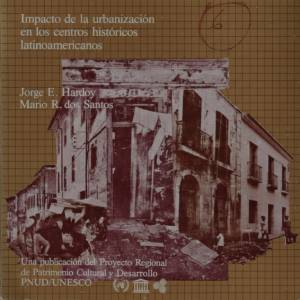
Hardoy, J. y dos Santos, M. (Coords.). (1983a). Impacto de la urbanización en los Centros Históricos de América Latina. PNUD/UNESCO- WHC Paris- Mapfre Madrid.
Hardoy, J. y dos Santos, M. (Coords.). (1983b). El centro histórico de Cusco. PNUD/UNESCO- WHC UNESCO- Banco Industrial del Perú.
Hardoy, J. y dos Santos, M. (Coords.). (1984). El centro histórico de Quito. PNUD/UNESCO- Banco Central de Ecuador.
Hardoy, J. (1989a). Los pueblos históricos de América Latina. Medio Ambiente y Urbanización, (27), 1-9.
Hardoy, J. (1989b). Los pueblos históricos en Argentina. Medio Ambiente y Urbanización, (27), 10-12.
Hardoy, J. Madrea, L. y Tartarini, J. (1988). Pequeños poblados históricos. Conservación y rehabilitación integral. DANA, (25), 92-109.
Koenz, P. (Informe final, febrero 1989). Misión externa de evaluación. Proyecto Regional de Patrimonio Cultural y desarrollo. PNUD/UNESCO.
Menchero, M. (2023). Financiación y cooperación internacional en el patrimonio cultural inmueble de los centros históricos coloniales latinoamericanos. Eure, 49(146), 1-22.
Monti, A. (2015). Jorge Enrique Hardoy, promotor académico, 1950-1976. UNR Editora.
Mutal, S. (2001). Ciudades y centros históricos de América Latina y el Caribe: 50 años de trayectoria (1950-1999). En F. Carrión (Ed.), Centros históricos de América Latina y el Caribe (pp. 113-138). FLACSO Ecuador.
Mutal, S. (1995, febrero 15). Culminación del Proyecto Regional RLA/91/029 PNUD/UNESCO: Patrimonio Cultural, Urbano y Ambiental. https://www.heritageanddevelopment.org/a.17.1.php
Pérez Winter, C. (2017). Rehabilitación y patrimonialización de los centros históricos en Argentina: la actuación de la Comisión Nacional de Museos Monumentos y Lugares Históricos (1980-1990). Andes, 28(2), s/p.
Pérez Winter, C. (2020). Los procesos de patrimonialización en la reactualización de la nación: la Comisión Nacional de Museos, Monumentos y Lugares Históricos en Argentina. Revista de Geografía Norte Grande, (75), 61-81.
Schávelzon, D. (2008). Mejor olvidar. La conservación del patrimonio cultural argentino. Academia de Historia de la Ciudad de Buenos Aires.
Published
How to Cite
Issue
Section
License
Copyright (c) 2026 A&P Continuidad

This work is licensed under a Creative Commons Attribution-NonCommercial-ShareAlike 4.0 International License.
Open access policy
A&P Continuidad is a non-profit and open access publication. According to Mexico Declaration on Cultural Policies, the journal distribution is submitted to Creative Commons Attribution-Noncommercial-ShareAlike 4.0 International Public License (CC BY-NC-SA). “Neither the commercial use of the original work nor that of the possible derivative works are allowed. The distribution of derivative works should be submitted to the license regulating the original work. This license is not free.”
A&P Continuidad authorizes the partial or full reproduction of texts and graphs provided that the source is cited. Authors are exclusively responsible for the criteria expressed in the articles which do not necessarily reflect the opinion of the Editorial Committee or that of the Direction Board. The copyright of the published articles pertains to their authors or publishers.
Transfer of rights
The acceptance of an article to be published implies the author’s transfer of rights to the journal. Authors continue to have the right to use the material in future books or publications, approve or veto the republication of their works as well as the rights related to patents or other rights. Transfer of rights form may be downloaded here.





























 This OJS site and its metadata are under a