
Catholic Church and the production of the Latin American habitat
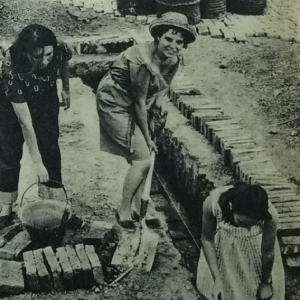
“First, people’s house; then, God’s house”: the work of Father José María Llorens in Mendoza
DOI:
https://doi.org/10.35305/23626097v13i24.551Keywords:
Catholic Church, habitat management, José María Llorens, informal settlements, developmentalismAbstract
During the developmentalist period (1955–1972) in Latin America, the problem of informal housing in urban peripheries became increasingly evident. Slums, shantytowns, callampas and favelas emerged as a central concern on the urban agenda of the time. Various sectors of the Catholic Church felt challenged by this situation of vulnerability and found in habitat management a way of mitigating social inequalities.
This paper proposes to link the work of Father José María Llorens —who settled in a slum in Mendoza in 1964— with different ideas circulating in Latin America about the new role of the Church and its attention to popular settlements. The focus is placed on the local scale while articulating this experience within a broader perspective which deals with the regional changes that shaped a renewed involvement of the Church in supporting popular housing as well as its impact on territorial configuration.
Downloads
Metrics
References
Álvarez, Y. (2009). Las reformas posconciliares y su impacto en Mendoza: El grupo de los 27 y el Movimiento de Sacerdotes para el Tercer Mundo. XII Jornadas Interescuelas/Departamentos de Historia. Departamento de Historia.
Álvarez, Y. (2010). La Revolución argentina y los inicios de la radicalización: Juventud universitaria y catolicismo posconciliar en Mendoza (1966-1973). Latinoamérica. Revista de Estudios Latinoamericanos, 51, 85-108.
Antes de dejar Mendoza el Padre Pierre visitó los barrios humildes. (1959, julio 10). Los Andes, 3.
Benmergui, L. (2009). The Alliance for Progress and housing policy in Rio de Janeiro and Buenos Aires in the 1960s. Urban History, 36(2), 303-326.
Bienvenido(a) a SELAVIP | SELAVIP. (s. f.). https://application.selavip.org/es
Blanco, J. (2021). “¿Qué tiene que ver la religión con esto?” Reconsideraciones sobre la influencia católica en los sindicatos durante el peronismo. Itinerantes. Revista de Historia y Religión, 15, 104-127.
Daich Varela, L. (2021). Acuerdos y encrucijadas en la Iglesia católica frente a la erradicación de villas porteñas durante la última dictadura militar (1976-1983). En V. Snitcofsky, E. Camelli, y A. Massidda (Eds.), Villas en Dictadura: Córdoba, Rosario y Buenos Aires (pp. 249-276). Café de las ciudades.
Devés Valdés, E. (2003). El concepto, el tema y el problema del desarrollo. En El pensamiento latinoamericano en el siglo xx: Desde la CEPAL al neoliberalismo 1950-1990.
Durante, M. E. (2022). ¿Una profesión militante o una militancia profesional? Aportes desde la historia reciente de la arquitectura. PENSUM, 8(9), 9. https://doi.org/10.59047/2469.0724.v8.n9.38743
Gallo, M. (1985) Primero la casa de los hombres después la casa de Dios. Tiempo Latinoamericano, 14-15. https://revistatiempolatinoamericano.com/rev/028/TL-028S08.pdf
Gargantini, D. M. (2003). Breve revisión histórica de la política habitacional argentina (Documento de Trabajo 015-03- Serie Arquitectura EDUCC). Secretaría de Investigación y Posgrado de la Universidad Católica de Córdoba.
Giannotti, E., y Soares-Gonçalves, R. (2020). La guerra fría en las favelas y las poblaciones, 1945-1964. Una disputa entre comunistas e Iglesia Católica. Izquierdas, 49. https://doi.org/10.4067/s0718-50492020000100235
Hoy llega a Mendoza el abate Pierre. (1959, julio 8). Los Andes, 4.
La Juventud se moviliza para ayudar al país. (1967). Siete días ilustrados, 118, 2-6.
Lida, M. (2015). Historia del catolicismo en Argentina. Entre el siglo XIX y el XX. Siglo XXI.
Llorens, J. M. (1964). Mensaje a responsables de la actividad privada por el R. P. José María Llorens S. J. Revista Oeste III(6), 17-21.
Llorens, J. M. (1972). Opción fuera de la ley. La tarde.
Llorens, J. M. (1983). Opción fuera de la ley. Alfa.
Longo, M. (1968). Campamentos universitarios de trabajo. Estudios, 590, 9-11.
Oszlak, O. (1989). Mercer la ciudad. Los pobres y el derecho al espacio urbano. CEDES.
Quiroga, L. (1968). Estudiantes. Buscadores de Miseria. Estudios, 589, 11-13.
Rodríguez Agüero, L. M. (2019). Redes sociales, catolicismo liberacionista y represión en el Barrio San Martín: Mendoza, 1959-1976. Prohistoria, XXII(31), 135-158.
Rodríguez, M. C., Virgilio, M. M. D., Procupez, V., Vio, M., Ostuni, F., Mendoza, M., y Morales, B. (2007). Producción social del hábitat y políticas en el Área Metropolitana de Buenos Aires: Historia con desencuentros. Instituto de Investigaciones Gino Germani, Facultad de Ciencias Sociales, UBA. http://bibliotecavirtual.clacso.org.ar/Argentina/iigg-uba/20100720101204/dt49.pdf
Snitcofsky, V. (2022). Historia de las Villas en la Ciudad de Buenos Aires: De los orígenes hasta nuestros días. Bisman. https://tejidourbano.net/biblioteca/historia-de-las-villas/
Zanca, J. (2020). Apuntes sobre la izquierda cristiana y la secularización en la Argentina. Prismas, 24(2). https://historiaintelectual.com.ar/wp-content/uploads/2020/10/D11-Zanca-2.htm
Published
How to Cite
Issue
Section
License
Copyright (c) 2026 A&P Continuidad

This work is licensed under a Creative Commons Attribution-NonCommercial-ShareAlike 4.0 International License.
Open access policy
A&P Continuidad is a non-profit and open access publication. According to Mexico Declaration on Cultural Policies, the journal distribution is submitted to Creative Commons Attribution-Noncommercial-ShareAlike 4.0 International Public License (CC BY-NC-SA). “Neither the commercial use of the original work nor that of the possible derivative works are allowed. The distribution of derivative works should be submitted to the license regulating the original work. This license is not free.”
A&P Continuidad authorizes the partial or full reproduction of texts and graphs provided that the source is cited. Authors are exclusively responsible for the criteria expressed in the articles which do not necessarily reflect the opinion of the Editorial Committee or that of the Direction Board. The copyright of the published articles pertains to their authors or publishers.
Transfer of rights
The acceptance of an article to be published implies the author’s transfer of rights to the journal. Authors continue to have the right to use the material in future books or publications, approve or veto the republication of their works as well as the rights related to patents or other rights. Transfer of rights form may be downloaded here.





























 This OJS site and its metadata are under a