
Al Borde Arquitectos: circulation and legitimation
Some moments of the emergence of ‘collectives’ and ‘activism’ concepts
DOI:
https://doi.org/10.35305/23626097v10i19.418Keywords:
Al Borde, architecture collectives, activism, circulation, disseminationAbstract
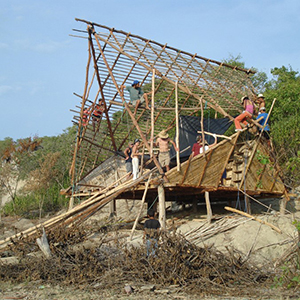
This article is focused on the first years of the professional history of Al Borde Arquitectos, an office established by David Barragán and Pascual Gangotena in Quito in 2007. Being internationally recognized, critics have broadly pointed out its work as one of the most important examples of the Architecture Collective’s movement, a somewhat problematic concept used to characterize practices attempting to become alternatives to conventional mechanisms of architectural production, and which are also interested in spatial agency and activism.
Throughout the text, some early years’ key moments of this office will be emphasized, carefully observing how the dissemination, circulation and reception of the work have occurred within the mediatic and institutional circuits, and how this framework has simultaneously developed interpretative categories. In this way, it is intended to shed light on the construction of the conceptualization of this architecture collective.
This contribution -far from trying to make a totalizing synthesis of the concept and its emergence- seeks to unravel the media-institutional framework that provides meaning and validation for this particular mode of space production. At the same time, it also intends to raise questions about the operability of this category in our contemporary context.
Downloads
Metrics
References
Awan, N., Schneider, T. y Till, J. (2011). Spatial Agency. Other ways of doing architecture. London and New York, UK and USA: Routledge.
Basulto, D. (2011). Plataforma Entrevista: Al Borde. ArchDaily México. Recuperado de https://www.archdaily.mx/mx/02-82551/plataforma-entrevista-al-borde
Cámara, C. (2013, agosto 15). Colectivos ¿oportunidad real o ficción deseada? Carlos Cámara Menoyo. Recuperado de https://www.carloscamara.es/blog/2013/02/15/colectivos-oportunidad-real-o-ficcion-deseada/
Casa Entre Muros / Al Borde (2009, agosto 26). ArchDaily en Español. Recuperado de https://www.archdaily.cl/cl/02-25319/casa-entre-muros-al-borde
Casa Pentimento / José María Sáez y David Barragán (2007, noviembre 22). ArchDaily en Español. Recuperado de https://www.archdaily.cl/cl/02-4279/casa-pentimento-jose-maria-saez-david-barragan
Di Peco, M. (2012). Arquitecturas del poder, arquitecturas del hacer. Revista Summa+ (122), 76-77.
Di Siena, D. (2012). Creatividad Horizontal: Redes, Conectores y Plataformas. Revista Arquitectura Viva (145), 20-21.
Durán Calisto, A. M. (2011). From Paradigm to Paradox: On the Architecture Collectives of Latin America. Harvard Design Magazine, (34), 24-33.
Escuela Nueva Esperanza / Al Borde (2010, enero 06). ArchDaily en Español. Recuperado de https://www.archdaily.cl/cl/626337/escuela-nueva-esperanza-al-borde
Fernández-Galiano, L. (2012). Colectivos necesarios. Revista Arquitectura Viva, (145), 3.
Griborio, A. (2020). Menos es todo. En A. Griborio (Ed.), Al Borde. Menos es todo (pp. 7-9). Ciudad de México, México: Arquine.
Latour, B. (2005). Reensamblar lo social. Una introducción a la teoría del actor-red. Buenos Aires, Argentina: Editorial Manantial.
Lepik, A. (2010). Small Scale, Big Change: New Architectures of Social Engagement. New York, EE. UU.: Museum of Modern Art.
López Munuera, I. (2012). Notas sobre el ‘bum’. Los colectivos españoles, un ecosistema plural. Revista Arquitectura Viva (145), 15-19.
Medina, F. y Videla, P. E. (2013). Otros mundos posibles. Revista Plot, (14), 8-22.
Montaner, J. M. (2013, febrero 06). Colectivos de arquitectos. El País. Recuperado de https://elpais.com/ccaa/2013/02/06/catalunya/1360177819_587334.html
Montaner, J. M. (2014). Del diagrama a las experiencias. Hacia una arquitectura de la acción. Barcelona, España: Gustavo Gili.
Montaner, J. M. (2015). La condición contemporánea de la arquitectura. Barcelona, España: Gustavo Gili.
Zabalbeascoa, A. (2012, octubre 20). Tras el tsunami de la crisis. El país. Recuperado de https://elpais.com/cultura/2012/10/17/actualidad/1350477728_747257.html?event=go&event_log=go&prod=REGCRARTCULT&o=cerrcult
Zaera Polo, A. (2012). Ya bien entrado el siglo XXI ¿las arquitecturas del post-capitalismo?, El Croquis (187), 253-287.
Published
How to Cite
Issue
Section
License
Copyright (c) 2023 A&P Continuidad

This work is licensed under a Creative Commons Attribution-NonCommercial-ShareAlike 4.0 International License.
Open access policy
A&P Continuidad is a non-profit and open access publication. According to Mexico Declaration on Cultural Policies, the journal distribution is submitted to Creative Commons Attribution-Noncommercial-ShareAlike 4.0 International Public License (CC BY-NC-SA). “Neither the commercial use of the original work nor that of the possible derivative works are allowed. The distribution of derivative works should be submitted to the license regulating the original work. This license is not free.”
A&P Continuidad authorizes the partial or full reproduction of texts and graphs provided that the source is cited. Authors are exclusively responsible for the criteria expressed in the articles which do not necessarily reflect the opinion of the Editorial Committee or that of the Direction Board. The copyright of the published articles pertains to their authors or publishers.
Transfer of rights
The acceptance of an article to be published implies the author’s transfer of rights to the journal. Authors continue to have the right to use the material in future books or publications, approve or veto the republication of their works as well as the rights related to patents or other rights. Transfer of rights form may be downloaded here.



























 This OJS site and its metadata are under a