Crossing Paths in Chambimbal: Albano, Vautier, and Fals Borda
Rural housing and community development in Latin America
DOI:
https://doi.org/10.35305/23626097v13i24.567Keywords:
CINVA, rural housing, Chambimbal Project, community developmentAbstract
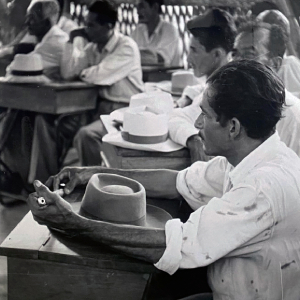
The article examines the articulation between disciplinary knowledge and practices in CINVA's Rural Housing Program (Programa de Vivienda Rural del Centro Interamericano de Vivienda y Planeamiento); it analyzes the transnational production of knowledge taking as the starting point the encounter between social worker Josephina Albano, sociologist Orlando Fals Borda, and architect Ernesto Vautier. Primary documents from CINVA Collection (Historical Archive, UNAL-CO) and Ernesto Enrique Vautier Documentary Collection (CEDODAL-Library of the Argentine National Congress) are linked to bibliographies on urban history and planning departing from the VI Regular Housing Training Course (1957) in Chambimbal, Buga, Colombia. CINVA is understood as a contact zone encompassing movements such as rural sociology, social Catholicism, and CEPAL's developmentalism to produce its own notions of comprehensive planning and community development. This work contributes to our knowledge of a crucial moment in which the fields of planning and social sciences converged on the problems of housing. Thus, it proposes a reflection on perspectives and programs that prioritized the rural world in development agendas.
Downloads
Metrics
References
Albano, J. (1957). El factor humano en la rehabilitación de tugurios. CINVA.
Almandoz, A. e Ibarra, M. (2024). Enmarcando la ciudad planificada en América Latina, 1940-1980: Desarrollo, territorio y planes sectoriales. RIL Editores.
Benmergui, L. (2009). The Alliance for Progress and housing policy in Rio de Janeiro and Buenos Aires in the 1960s. Urban History, 36(2), 303-326.
Bielschowsky, R. (Org.). (2000). Cinquenta anos de pensamento na CEPAL. Vol 1. Record.
Carlson (1957). Introducción. En J. Albano, El factor humano en la rehabilitación de tugurios. CINVA.
CINVA. (1956a). Proyecto Sogamoso-Paz del Río: Ensayo de una metodología. Archivo Central e Histórico (Fondo CINVA), UNAL.
CINVA. (1956b). Proyecto rural de San Jerónimo. Archivo Central e Histórico (Fondo CINVA), UNAL.
CINVA. (1957). Proyecto rural Chambimbal: Estudio de la vivienda y de la comunidad en una vereda colombiana. Archivo Central e Histórico (Fondo CINVA), UNAL.
CINVA. (1958). Curso de vivienda rural en Brasil. Archivo Central e Histórico (Fondo CINVA), UNAL.
CINVA. (1961). Experiencias sobre vivienda rural en el Brasil. Archivo Central e Histórico (Fondo CINVA), UNAL.
Cortes, A. (2012). Modernización, dependencia y marginalidad: Itinerario conceptual de la sociología latinoamericana. Sociologías, 14(29), 214-245.
CVC. (2004). Génesis y desarrollo de una visión de progreso: Corporación Autónoma Regional del Valle del Cauca -CVC- Cincuenta años. https://ecopedia.cvc.gov.co/sites/default/files/archivosAdjuntos/cvc-50_anos-cap-2_ok-c.pdf
Fals Borda, O., Vautier, E., y Albano, J. (1958). Manual de investigación y extensión en vivienda rural. CINVA. Archivo Central e Histórico (Fondo CINVA), UNAL.
Fondo Documental Ernesto Enrique Vautier. (s.f.). Documentos EEV-059 / EEV-189 / EEV-190 / EEV-091 / EEV-192 / EEV-097 / EEV-305 / EEV-319. Biblioteca del Congreso de la Nación Argentina.
Gonçalves, R. S., y Santos, C. R. (2022). Favelas cariocas: Da noção de marginalidade à ideia de margens urbanas. Revista De Direito Da Cidade, 14(3), 1884-1905.
Gorelik, A. (2022). La ciudad latinoamericana: Una figura de la imaginación social del siglo XX. Siglo XXI Editores.
Jaramillo, J. (1996). Campesinos de los Andes: Estudio pionero de la sociología colombiana. Revista Colombiana de Sociología, 3(1), 53-82.
Joseph, G. M., LeGrand, C., y Salvatore, R. (Eds.). (1998). Close encounters of empire: Writing the cultural history of U.S.-Latin American relations. Duke University Press.
Lopes, T. y Maio, M. (2022). Sociólogos rurais, modernização e ideais de comunidade na América Latina: O caso do Office of Foreign Agricultural Relations (1930-1940). Dados, 65(1), 1–41. https://doi.org/10.1590/dados.2022.65.1.255
Montoya, A., Ramírez, J., y Aravecchia-Botas, N. (Eds.). (2024). El CINVA: Un proyecto latinoamericano 1951-1972. IEU-UNAL.
Obregón, D. (1987). Sociología, de la palabra al concepto. Revista Colombiana de Sociología, 5(1), 72-77.
Pereira Fernández, A. (2008). Fals Borda: La formación de un intelectual disórgano. Anuario Colombiano de Historia Social y de la Cultura, (35), 375-411.
Pratt, M. L. (2009). Ojos imperiales: Literatura de viajes y transculturación. Fondo de Cultura Económica.
Soares Gonçalves, R., y Benmergui, L. (2022). Maria Josephina Rabello Albano: Uma assistente social transnacional. O Social em Questão, (54), 111-136.
Vautier, E. (1958). Programa de vivienda rural del CINVA. Archivo Central e Histórico (Fondo CINVA), UNAL.
Vautier, E., y Fals Borda, O. (1958). La vereda de Chambimbal: Estudio y acción en vivienda rural. Archivo Central e Histórico (Fondo CINVA), UNAL.
Vicién, J. (1960). Resumen de las clases de sociología rural dictadas en el curso de vivienda organizado por la OEA. Archivo Central e Histórico (Fondo
Published
How to Cite
Issue
Section
License
Copyright (c) 2026 A&P Continuidad

This work is licensed under a Creative Commons Attribution-NonCommercial-ShareAlike 4.0 International License.
Open access policy
A&P Continuidad is a non-profit and open access publication. According to Mexico Declaration on Cultural Policies, the journal distribution is submitted to Creative Commons Attribution-Noncommercial-ShareAlike 4.0 International Public License (CC BY-NC-SA). “Neither the commercial use of the original work nor that of the possible derivative works are allowed. The distribution of derivative works should be submitted to the license regulating the original work. This license is not free.”
A&P Continuidad authorizes the partial or full reproduction of texts and graphs provided that the source is cited. Authors are exclusively responsible for the criteria expressed in the articles which do not necessarily reflect the opinion of the Editorial Committee or that of the Direction Board. The copyright of the published articles pertains to their authors or publishers.
Transfer of rights
The acceptance of an article to be published implies the author’s transfer of rights to the journal. Authors continue to have the right to use the material in future books or publications, approve or veto the republication of their works as well as the rights related to patents or other rights. Transfer of rights form may be downloaded here.























 This OJS site and its metadata are under a