
Unorthodox atlas of Heritage Landscapes in the coastal system of Villa Constitución
DOI:
https://doi.org/10.35305/23626097v11i20.446Keywords:
atlas, mestizo landscape, industrial heritage, wetland, collective memoryAbstract
This article is based on the research for the Master’s Thesis Project in Landscape Architecture (Asorey, 2023). It recognizes the transformations that took place over time -ranging from the nineteenth century to the present- in Puerto Las Piedras on the coastal area of Villa Constitución. The still productive structures shaping the industrial landscape in a fragmented port are highlighted. The construction of the causeway as a dike for the navigation channel gives rise to a new sedimentary space which is an urban wetland. Nowadays, it is a Natural Protected Area connecting Cafferata Island, current port’s Unit 1 and the city.
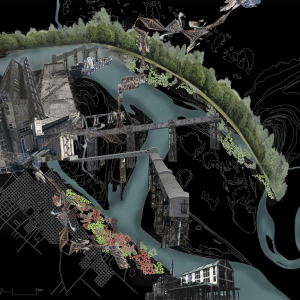
We formulate an unorthodox Atlas as a conclusive way of defining the mestizo landscapes, i.e., heritage, hybrid, natural, urban, productive, archaeological, historical, tangible and intangible landscapes. They are also part of the social landscape, the collective memory of the territory and the synergies occurring between nature and human construction.
This dynamic tool called Atlas seeks to continue with the expansion, research and appraisal of the mestizo landscape so as to deal with future interventions in the analyzed coastal buffer, the peninsula-wetland, the city, the territory and the region.
Downloads
Metrics
References
Ábalos, I. (2005). Atlas pintoresco. El observatorio (Vol. 1). Málaga, España: Editorial Gustavo Gili.
Asorey, G. (2023). Atlas para la reconstrucción del paisaje mestizo. Los rieles, la península y el humedal en el enclave Villa Constitución. (Tesis de maestría). Repositorio hipermedial, FAPyD UNR.
Cruz Legrá, S. M (2011). Visión martiniana del paisaje de nuestra América. La Habana, Cuba: Editorial Ácana Camagüei.
De Sousa Santos, B. (2010). Para descolonizar Occidente: más allá del pensamiento abismal. Buenos Aires, Argentina: Prometeo Libros.
Denzin, N. (2013). Autoetnografía analítica o nuevo déjà vu. https://doi.org/10.55441/1668.7515.n11.6310
Ellis, C. (2015). Autoetnografía: un panorama. https//doi.org/10.55441/1668.7515n14.11626
Fernández, R. (1998). El laboratorio americano: arquitectura, geocultura y regionalismo. Madrid, España. Editorial Biblioteca Nueva.
Fernández, R. (2010). Ecología artificial. (F. UBA, Ed.) Buenos Aires, Argentina: Editorial Concentra.
Guba, E. y Lincoln, Y. (2000). Paradigmas en competencia en la investigación cualitativa. C. Denman y J. A. Haro (Comp.), Por los rincones. Antología de métodos cualitativos en la investigación social (pp. 113-145). Sonora, México: Colegio de Sonora.
Hays, D. (2019). Conferencia Magistral Prototyping and the Critical Practice of Landscape Architecture. En Simposio Debates contemporáneos en Arquitectura del Paisaje 2019. FAPyD UNR, Rosario.
Nogué, J. (Ed.). (2007). La construcción social del paisaje. Biblioteca Nueva: Madrid.
Sauer, C. (1925) The Morphology of Landscape. California, USA : California University.
Silvestri, G. (2003). El color del río. Historia cultural del paisaje del Riachuelo. Buenos Aires, Argentina: Editorial UNQ.
Published
How to Cite
Issue
Section
License
Copyright (c) 2024 A&P Continuidad

This work is licensed under a Creative Commons Attribution-NonCommercial-ShareAlike 4.0 International License.
Open access policy
A&P Continuidad is a non-profit and open access publication. According to Mexico Declaration on Cultural Policies, the journal distribution is submitted to Creative Commons Attribution-Noncommercial-ShareAlike 4.0 International Public License (CC BY-NC-SA). “Neither the commercial use of the original work nor that of the possible derivative works are allowed. The distribution of derivative works should be submitted to the license regulating the original work. This license is not free.”
A&P Continuidad authorizes the partial or full reproduction of texts and graphs provided that the source is cited. Authors are exclusively responsible for the criteria expressed in the articles which do not necessarily reflect the opinion of the Editorial Committee or that of the Direction Board. The copyright of the published articles pertains to their authors or publishers.
Transfer of rights
The acceptance of an article to be published implies the author’s transfer of rights to the journal. Authors continue to have the right to use the material in future books or publications, approve or veto the republication of their works as well as the rights related to patents or other rights. Transfer of rights form may be downloaded here.




























 This OJS site and its metadata are under a